Finding the best commercial mortgages is not as simple as looking for the lowest advertised rate. The ‘best’ lender is the one that gives you the strongest outcome for your specific project, based on leverage, cost, speed, appetite and certainty.
How to Find The Best Commercial Mortgages
For commercial investors, not recognising the distinction between a seemingly good deal and the right deal can be expensive, with the average difference in net borrowing on a £1m commercial mortgage being a whopping £151,000.
This article explains what ‘best’ really means in commercial mortgages, the mistakes borrowers make when comparing lenders, how banks and alternative lenders differ, and how to compare the market properly for your asset, strategy and location.
What does ‘best commercial mortgage’ actually mean?
There’s no universal best commercial mortgage lender. A lender that’s competitive on a standard owner-occupied office may be the wrong fit for a semi-commercial investment.
The best option depends on the mechanics of the deal, including:
- Property type and location
- Loan-to-value requirement
- Rental income and debt service cover
- Borrower experience and financial strength
- Asset condition and future plans
- Lender risk appetite
Hence, generic ‘top lender’ lists can be misleading. Lenders assess risk differently, stress income differently, treat asset classes differently and have changing appetite across regions and borrower profiles.
To help borrowers understand what a good deal looks like and to highlight the costs of opting for the wrong lender, we analysed over 100 real-world, like-for-like £1m commercial property scenarios. We found that choosing the wrong lender could reduce available funding by £100k–£600k on a single deal, with an average net loan difference of £151,000 between the best and worst leveraged deal.
The most expensive mistakes developers make
The numbers show that the most expensive mistake in commercial mortgages is not comparing properly. Many borrowers still rely on manual loan sourcing, approaching familiar lenders or a small panel of contacts, causing colossal blind spots.
Common mistakes include:
- Assuming high street banks offer the best rates
- Overlooking specialist and alternative lenders
- Focusing only on headline rates and ignoring fees, leverage, stress testing and covenants
- Having no awareness of lender appetite before submitting
- Returning to the same lender out of familiarity / misplaced loyalty
Borrowers often believe they’ve secured a competitive facility because the rate looks attractive. But if that lender offers £151,000 less than another credible option, the borrower is forced to inject more equity than necessary, creating huge opportunity costs for commercial investors.
On top of that, amongst the best leveraged deals, we also found that monthly repayments can differ by up to £785 per month.
A better deal can cost less per month but crucially it frees up capital, enabling the borrower to complete with less equity and invest elsewhere. Without properly comparing the market borrowers face reduced leverage and increased costs. Compounded over multiple deals across the span of an investment career, it’s a life-changing mistake.
Banks vs alternative lenders for commercial mortgages
High-street banks typically offer the lowest rates (5-6.5% per annum) but cap LTV at 60-65%, apply conservative stress testing, and can take 6-12 weeks or more to complete. They're strongest on stabilised, tenanted assets with clean borrower profiles.
Alternative lenders, including challenger banks, specialists and non-bank funds, price higher (6.5-12%) but offer LTVs up to 75%, completion in 3-4 weeks, and greater comfort with transitional assets, complex structures and non-standard income. Crucially, less conservative stress testing means the net loan is often significantly higher than a bank would offer on the same deal.
That gap is bigger than most borrowers expect. In our analysis of £1M commercial mortgage scenarios, the difference between the best and worst net loan was £250,000. In most cases the lowest-rate bank came with the lowest net loan.
The simplest rule: if the asset is stabilised with strong income and no time pressure, a bank will likely win on cost. If the asset is transitional or you need speed or maximum leverage, an alternative lender will usually deliver a stronger outcome. The best approach is to compare both. Brickflow includes banks and alternative lenders on the same platform so you can see how terms compare for your specific deal.
Read more about Researching Commercial Mortgages in the UK Market.
Which lenders are best for different scenarios?
Different scenarios require different lender strengths. A semi-commercial property naturally needs a lender with confidence in mixed-use income. A refurb project needs a lender that understands improved valuation, stabilised income and timing. A development exit may need more flexible underwriting while the asset transitions from completion to occupation. For portfolio acquisitions, the priority may be structure and scalability.
The strongest lenders can also change with regional assets. For example, the most active lenders in commercial mortgages across London might offer the least competitive deals in Scotland.
This is why comparison tools are essential, enabling borrowers to see details on:
- Rate and total cost
- Arrangement, exit and valuation fees
- Maximum leverage and net loan
- Monthly repayments
- DSCR and stress testing assumptions
- Asset class and regional appetite
If I wanted commercial property finance with flexible terms, which lenders would be worth considering?
Flexible terms can mean different things depending on your strategy: interest-only periods (typically one to five years before switching to repayment), the ability to overpay without penalty, early repayment options outside of the fixed period, or term extensions if your plans change.
High-street banks tend to be the least flexible, with rigid fixed-rate periods and early repayment charges that lock borrowers in for the full term. Challenger banks and non-bank lenders are generally worth considering first, as they're more willing to structure facilities around the borrower's exit plan, particularly where there's a clear intention to refinance once rental income stabilises or to sell within a defined window.
Brickflow lets you filter by repayment type and term structure to quickly identify which lenders offer the flexibility your strategy requires.
For more on structuring your first commercial deal, read our guide on how to finance your first commercial property.
How to compare commercial mortgage lenders effectively
To compare commercial mortgage lenders effectively, follow this step-by-step Process:
- Define your deal parameters
- Use Brickflow to search the market
- Compare LTV, rate, fees, and terms side-by-side
- Shortlist 3-5 lenders
- Apply via Smart Appraisal.
Start with the deal, not the lender. Define the loan purpose (purchase, refinance, development exit, portfolio expansion, etc.), the asset type, timelines, exit (on interest-only deals), income profile and borrower.
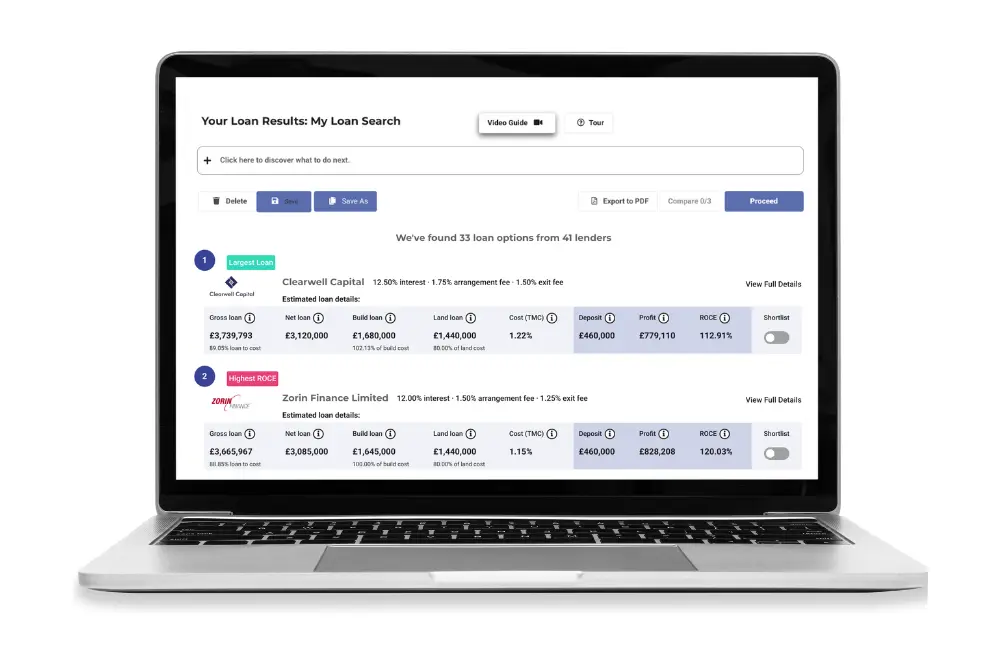
Once the deal is clear, the fastest, most effective way to compare commercial mortgage lenders is by running it through a good comparison platform. Use Brickflow to search the market in seconds, and see which lenders fit your criteria.
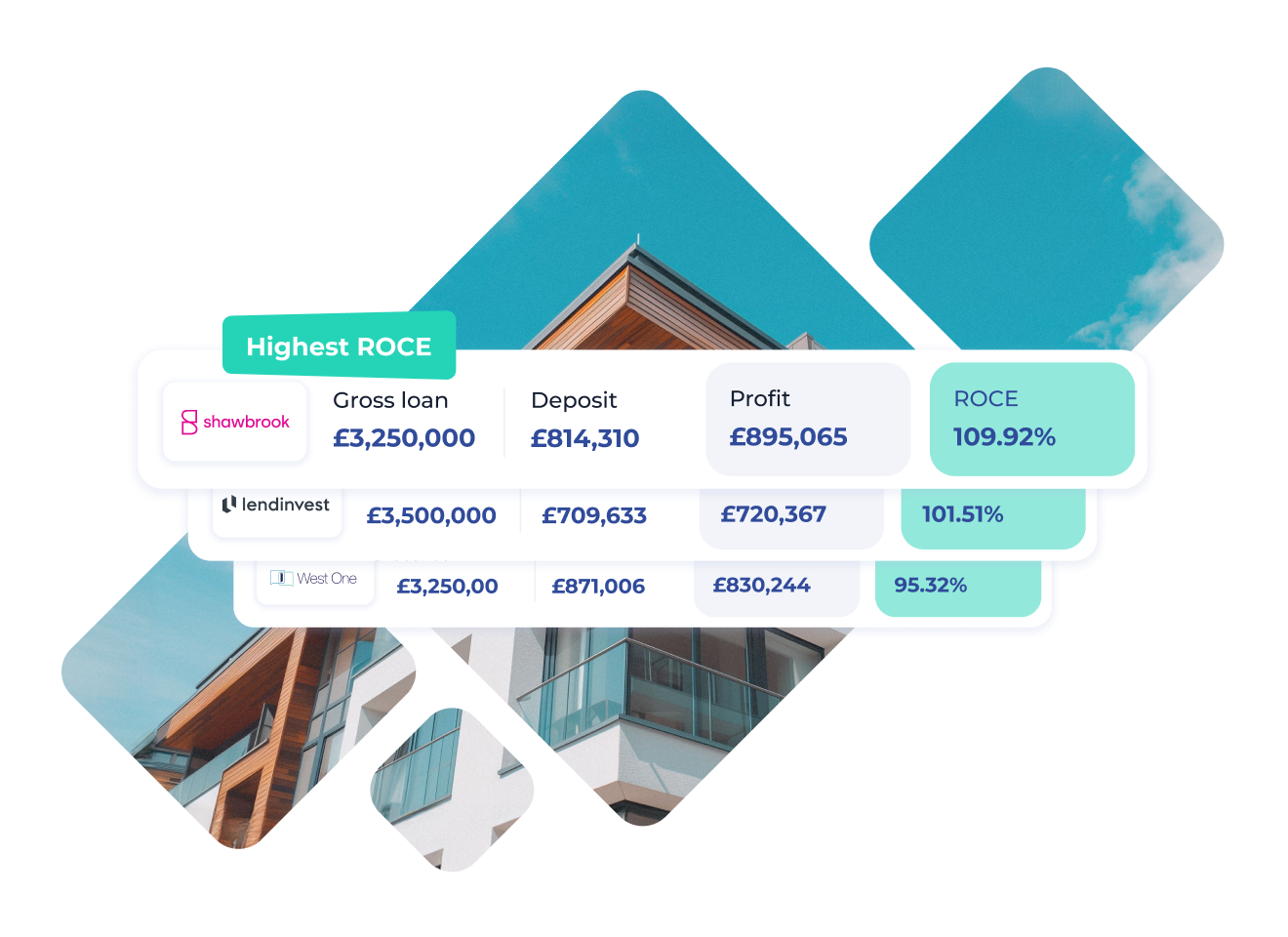
Compare LTV, rate, arrangement fees, repayment structure and stress testing side by side, focusing on net loan and total cost rather than headline rate. Shortlist three to five lenders based on deal fit, then apply using Brickflow's Smart Appraisal, which sends a single application to multiple lenders without repetitive form-filling.
A strong comparison should include everything mentioned above (rates, fees, total costs, LTV, net loan, repayment structure, monthly costs, lender appetite), and provide details on underwriting criteria, loan terms and covenants.
Brickflow gives borrowers access to this kind of comparison in seconds, helping commercial investors see real lender appetite, real criteria and real deal outcomes from across the market.
Find out more about Researching Commercial Mortgage Markets in the UK and How Comparison Platforms Work in Property Finance.
Why comparison matters over time
A £151,000 funding shortfall on one deal may feel manageable, but repeated across multiple acquisitions or refinances, it materially hinders growth.
More capital input requirements today means less equity for tomorrow’s purchase. That means fewer deals completed, more missed acquisitions, slower portfolio growth and lower ROI (Return on Investment).
Over a career, that opportunity cost can easily become tens of millions of pounds.
The best commercial mortgages are not found by guessing, relying on familiar lenders, or accepting the first apparently competitive term sheet from a broker who relies on manual loan sourcing. They are found by comparing the whole market against the specifics of the deal.
For serious borrowers, comparison is now a strategic advantage. It protects capital, improves decision quality and helps ensure that every project is financed on the strongest possible terms available.