Mixed-use property offers strong investment opportunities, but it can also make financing more complicated. Buildings or sites that combine residential and commercial units often fall outside the criteria of standard mortgage lenders, particularly if the asset is vacant, undergoing refurbishment, or being repositioned.
This is where bridging loans for mixed-use property in the UK are commonly used. Bridging finance allows investors and developers to acquire or stabilise a mixed-use asset before refinancing onto longer-term debt or selling the property.
The key questions for most borrowers is how bridging finance works for mixed-use property in the UK, how lenders assess their specific deal, how it will be priced, and what exit strategy is required. This guide answers these questions and discusses why comparing loans from across the market is essential to get the best deal.
With more lenders now offering dedicated mixed-use products in 2026, pricing and criteria can vary widely from one to the next, so it's worth using our bridging loan calculator early on to get a realistic view of costs before you start comparing.
Can You Use a Bridging Loan for a Mixed-Use Property in the UK?
Yes, mixed-use property bridging loans are widely available in the UK, but bridging loan lenders assess these assets differently from purely residential or purely commercial property.
Bridging finance is designed as short-term funding, typically ranging from 1 to 24 months, allowing borrowers to secure a property while they stabilise the asset or implement a strategy that makes it suitable for long-term finance. In other words, it’s often a transitional transaction tool.
For mixed-use buildings, bridging loans are commonly used to:
- Acquire a property before refinancing onto a semi-commercial or commercial mortgage
- Purchase assets that are not currently mortgageable
- Complete refurbishment works
- Reconfigure the residential and commercial mix
- Secure auction purchases where completion deadlines are tight
Typically, lenders offer rolled-up or retained interest structures, meaning interest is added to the loan and paid on loan redemption, rather than paid monthly. This is particularly useful where the property is not yet income producing.
In mixed-use situations, lenders usually analyse the residential and commercial elements separately. The residential/commercial split, or the commercial weighting, can influence how the loan is structured and which lenders are willing to fund the deal.
What If The Property Isn’t Mortgageable Yet?
Mixed-use bridging finance is often the only viable option when the building is not yet eligible for standard mortgage finance.
Bridging is frequently used to unlock deals that have issues preventing them from securing funding from long-term lenders, such as:
- Vacant commercial units: Most mortgage lenders require established, income-producing tenants before they will provide funding. Bridging allows you to purchase the property and secure tenants to stabilise the income.
- Short leases: If a residential or commercial lease is too short for a mortgage provider's criteria, bridging finance covers the acquisition while you extend/renegotiate the lease or execute a change of use.
- Structural issues or poor condition: If the property requires refurbishment or has structural problems preventing a standard valuation, bridging finance can cover the purchase and the remedial works. You can read more about refurbishment finance in our dedicated guide.
- Below-market-value purchases or auction acquisitions: Bridging offers the speed and certainty needed to complete a rapid acquisition, often before you have time to arrange permanent finance.
In these scenarios, bridging loans for mixed-use property UK-wide act as the flexible capital needed to acquire the property and stabilise it before moving onto a standard or semi-commercial mortgage once the asset meets long-term lending criteria.

How Lenders Assess Risk on Mixed-Use Bridging Loans
Mixed-use bridging loans require more detailed underwriting than purely residential bridging because the lender must evaluate both the commercial and residential components of the asset.
Several factors typically drive lender appetite and loan terms.
Residential vs Commercial Proportion
One of the first things lenders consider is the percentage split between the residential and commercial spaces.
Properties with a higher residential proportion are often considered lower risk because residential demand and financing options are generally stronger. For example:
- A building with one shop and several flats above may be treated as a semi-commercial asset.
- A building where commercial space dominates may be assessed closer to a commercial investment property.
Higher commercial exposure can affect:
- Maximum loan-to-value (LTV)
- Interest rates
- Which lenders are willing to participate
Lenders will scrutinise the stability of the commercial income, the type of business, the strength of the tenant covenant, and the current rental yield to determine the overall risk profile and subsequent pricing.
Planning Risk and Change of Use
Mixed-use buildings are frequently purchased with the intention of changing the use of part or all of the property.
A common example is converting commercial space into residential units, either through planning permission or permitted development rights.
Bridging can be an ideal fit for any planning uplift strategies, but lenders will want clarity around:
- The planning strategy
- The likelihood of approval
- The timeline for the project
- How the exit will work once changes are complete
When planning risk is involved, the lender's comfort hinges on one thing: exit clarity. Since the value of the asset may depend on successful planning approval, lenders must trust that if it fails, you have a solid Plan B (like refinancing the current mixed-use structure or selling it as is).
Borrower Experience and Exit Strategy
The strength of your exit strategy can often outweigh the asset’s complexity, and your borrower profile. Naturally, lenders want certainty that they will be repaid. The most common and preferred exit strategies for mixed-use bridging finance include:
- Term Refinance: Moving to a long-term Buy-to-Let or commercial mortgage once the asset is stabilised (tenants are in, works are complete).
- Sale after Refurbishment: Selling the property for a profit once the value has been uplifted by refurbishment or conversion, or securing planning.
- Development Exit Loan: If your project involves heavy development, you might exit onto specialist development finance before a final term mortgage.
Nonetheless, lenders will assess your track record. An experienced developer with a clear, well-articulated strategy has more chance of loan approval, more favourable terms and potentially better pricing than a novice investor can secure, even on the same asset.
Rates and Costs for Mixed-Use Bridging Loans
Like all bridging finance, pricing for mixed-use bridging loans varies depending on the risk profile of the deal. Because these assets combine residential and commercial elements, they involve a different underwriting process from purely residential or purely commercial property, and hence different rates.
Are Rates Higher for Mixed-Use Properties Compared to Single-use Buildings?
Generally, bridging loans for mixed-use properties carry a modest complexity premium compared with single-use residential buildings, so rates tend to be higher.
This is because fewer lenders are active in the mixed-use property space, valuations are more complex, additional underwriting is required, and they carry higher perceived risk due to:
- Commercial Exposure: Commercial property markets can be more volatile than pure residential, leading lenders to price in this additional risk.
- Valuation Considerations: Residential and commercial elements often need to be valued separately, making mixed-use valuations are inherently more subjective, particularly when the split is uneven or the commercial unit is vacant.
- Exit Risk Pricing: Exit strategy can be harder to underwrite when the asset serves multiple purposes. If the exit relies heavily on a complex commercial sale or a tricky refinance, the lender may reflect this in the rate.
While pure residential bridging loans typically have the lowest rates across bridging finance, and commercial-only bridging tends to be the most expensive, mixed-use bridging typically sits between the two.
If the residential proportion is high and the exit is straightforward, pricing can be comparable to standard bridging loans. Respectively, properties with a high commercial weighting or planning risk may be priced closer to commercial bridging finance.
Rate premiums vary, but a mixed-use bridge at 65% LTV might price 0.1% to 0.3% per month higher than a comparable single-use residential deal. That said, the spread between lenders on mixed-use is also wider, which means the difference between shopping the market and going with the first offer is often greater than for standard deals.
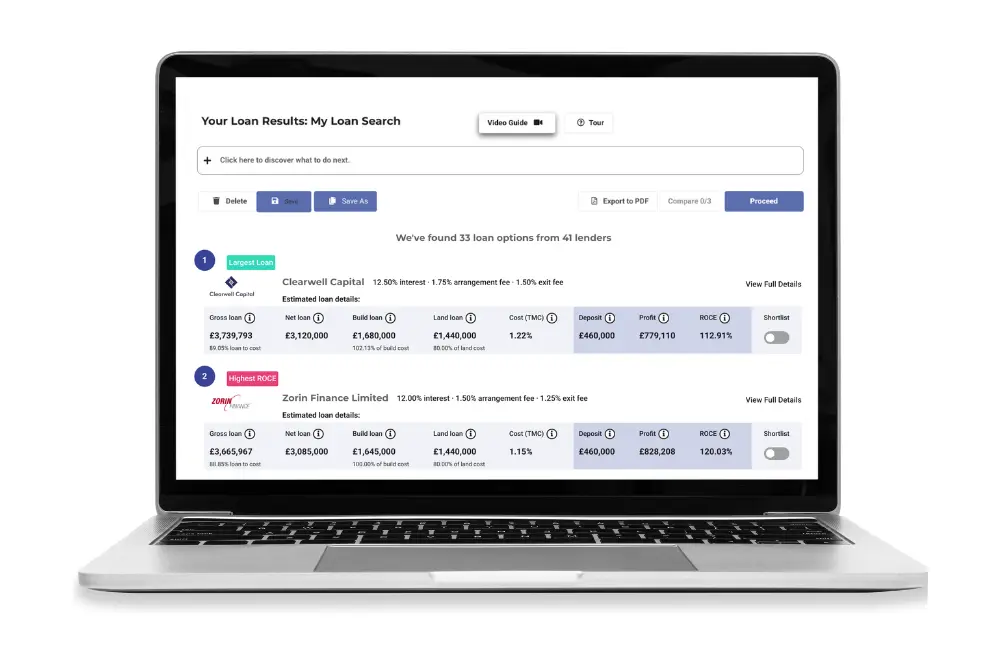
Brickflow filters lenders by property type, so you can instantly see which lenders fund mixed-use and compare their rates against single-use options for the same loan amount and LTV.
Read more about the difference between commercial and residential bridging loans.
What Impacts Pricing Most?
Several factors typically influence the cost of bridging finance for mixed-use development or investment.
Key variables include:
- LTV (Loan-to-Value): A lower LTV (e.g., 50-60%) signals less risk and results in lower rates.
- Commercial Percentage: From a lender’s point of view, residential units are far easier to liquidate than commercial properties in the event of a default on the loan. Less commercial exposure typically means better rates.
- Borrower Experience: Your track record as a developer or investor mitigates risk in the eyes of the lender.
- Exit Clarity: A guaranteed, clear exit plan (e.g., a mortgage agreement in principle, or high-demand asset sale) can significantly improve lender confidence and reduce risk pricing.
- Asset Quality: Prime location and strong tenant covenant will always be more attractive to lenders.
Can Bridging Cover Purchase and Refurbishment?
Whether you’re buying and refurbishing part or all of a mixed-use building, bridging finance can be structured to cover both the property purchase and the subsequent refurbishment works.
Refurbishment bridging loans can typically cover up to 75% of the property purchase value, and up to 100% of the refurbishment costs. How it works depends on the scale of your project. Some lenders may determine whether the refurbishments are light or heavy based on the cost of the refurbishment works – anything less than 15% of the value of the property would be considered light.
Light refurbishment
Lighter refurbishment projects usually involve internal upgrades like replacing bathrooms and kitchens, cosmetic works, improving EPC ratings, or reconfigurations that don’t require planning permission. The bridging facility might be structured with an initial advance to cover the purchase price (minus your deposit) followed by the funds for the refurbishment work after the property sale is completed.
Heavy refurbishment
Heavy refurbishment work generally requires planning permission like structural changes, change of use, extensions, garages, and conversion. Refurbishment bridging loans work more like development finance with staged drawdowns. This means funds for the refurbishment works are released in stages linked to construction milestones, and verified by a Monitoring Surveyor. This ensures cost control and that the lender's security is increasing alongside the asset's value.
Your loan application must cover the level of work: a simple cosmetic refurbishment is treated differently from a structural redevelopment, has a lower-risk profile and can be funded with a straightforward ‘fix and flip’ bridging loan. Heavy refurbishments involve additional third parties, project monitoring and different LTV caps.
How to Compare Bridging Lenders for Mixed-Use Property in the UK
Not all bridging finance lenders approach mixed-use property in the same way. Some specialise in semi-commercial assets, while others focus primarily on residential bridging and may have strict limits on commercial exposure.
Understanding lender appetite can therefore be just as important as comparing headline interest rates.
Not All Lenders Are Comfortable with Mixed-Use
You need to compare lenders based on their appetite for your specific deal, looking at:
- Maximum Commercial Exposure: Some lenders cap commercial space in a mixed-use property at 30% of the value; others will go up to 80% or higher.
- Appetite for Planning Risk: Not all lenders fund planning-led strategies, so it’s about finding those that comfortably operate in this space. Using criteria filters on Brickflow's instant bridging loan comparison eliminates lenders who don’t fund purchases without planning / planning in progress.
- Flexibility on Exit: Some lenders are highly restrictive on the exit strategy while others allow a degree of flexibility if the exit changes (e.g., from refinance to sale).
- Experience with Development: If your project involves heavy refurb, it’s best to work with a lender with a strong track record in construction and staged drawdowns.
Where Can You Compare Mixed-Use Bridging Options?
Comparing bridging loan options for mixed-use property developments in the UK is essential to find the best deal for your property investment, and there are a number of ways to do this.
-
Work with a Specialist Broker: A broker specialising in commercial and complex property finance understands the bespoke criteria of lenders, and gives you wider access to the bridging loan market.
-
Use a comparison platform: Platforms like Brickflow allow investors and developers to compare bridging lenders across the market, giving unbiased, like-for-like details on rates, fees, LTVs and lender criteria
When comparing mixed-use bridging finance, look at all costs rather than just the rate, which means factoring in arrangement fees, exit fees (if applicable), legal costs, and monitoring surveyor fees to compare the true total cost of the loan.
Also, prioritise speed and certainty–the right lender is one who can process the specifics of your mixed-use deal quickly and provide certainty of funds, rather than the cheapest loan.
To understand more about how to compare loans and lender suitability, head to our bridging loan comparison page, and for detailed and accurate loan figures and costs, run your numbers through Brickflow’s bridging loan calculator.